
Introduction
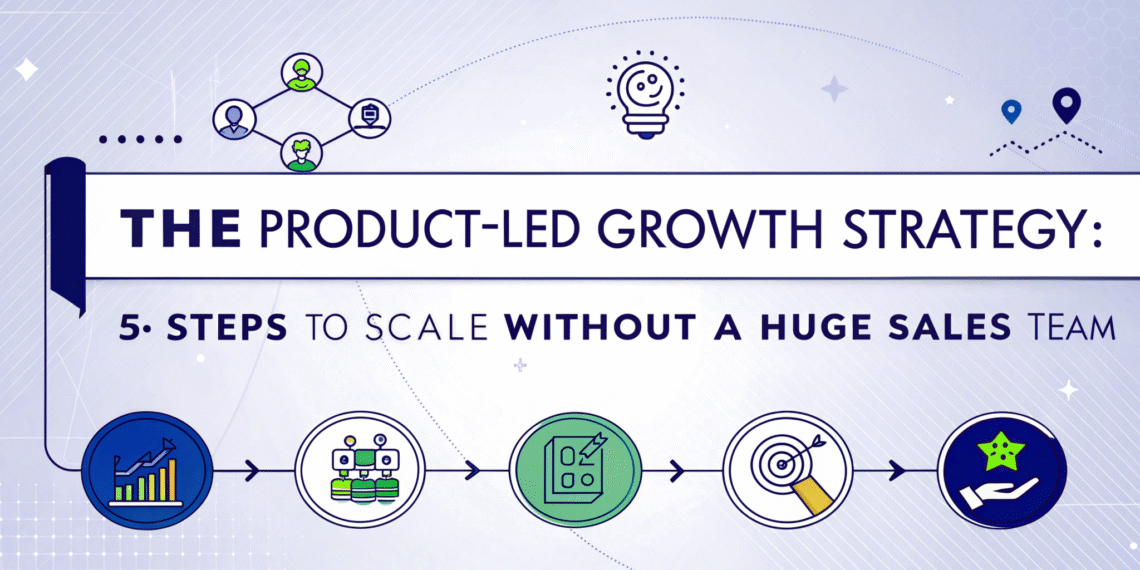
“Product-Led Growth Strategy (PLG) is revolutionizing how SaaS companies acquire, convert, and retain users in 2025.”In 2025, the traditional sales model (sales demos, cold calls) is rapidly being replaced by the Product-Led Growth (PLG) strategy. PLG is a go-to-market model where the product itself is the primary driver of customer acquisition, conversion, and expansion. Think of Zoom, Slack, or Canva—you start using the free tool, love it, and upgrade when you need more features. This strategy is essential for startups and small businesses because it scales rapidly and cheaply, bypassing the need for a massive, expensive sales team. I’ve personally advised multiple SaaS companies on pivoting to PLG, resulting in faster onboarding, higher user retention, and better conversion rates from free to paid. This guide outlines the 5 key pillars of a successful product-led growth strategy, focusing on practical steps, E-E-A-T building, and real-world examples to help you turn your product into your best salesperson.
Pillar 1 — Define the Fremium Value & Pricing Strategy
The “Aha!” Moment: Users must experience the core value (the “Aha!” moment) of your product within minutes, not days.
The Fremium Gate: Determine what features go into the free tier and what triggers the upgrade. The free tier must be valuable enough to keep them hooked, but limited enough to justify an upgrade.
Actionable Step: The free product should solve one critical problem completely, while the paid product solves multiple, broader problems.
Pillar 2 — Engineer a Frictionless Onboarding Experience
Focus: Users should sign up and be using the key feature (the “Aha!” moment) with zero friction and without talking to a salesperson.
Eliminate Gatekeepers: Do not require credit card details or excessive personal information during signup.
In-App Guidance: Use tooltips, short walkthroughs, and progress bars directly inside the app to guide them.
E-E-A-T Focus: Your product should instantly demonstrate its expertise (E) by being easy to use and delivering immediate value.
Pillar 3 — Embed Virality into the Core Product
Focus: Design your product to require or encourage sharing to maximize its value (as detailed in the viral growth tactics).
Examples:
Calendly: The output (a scheduling link) is the viral component that gets shared.
Google Docs: Requires inviting collaborators to edit a document.
Actionable Step: Use the product’s output (shared document, invite link, exported file) as a branded touchpoint back to your service.
Pillar 4 — The In-App Conversion Strategy
Contextual CTAs: Prompt the user to upgrade at the exact moment they hit the freemium limit.
Bad: General “Upgrade Now” banner on the home screen.
Good: A user tries to export a file with a watermark, and a tooltip pops up saying, “Unlock watermark-free exports with Pro for $9/month.”
The Sales Assist Team: PLG doesn’t mean zero sales. It means sales only engage with highly qualified leads (PQLs—Product Qualified Leads) who are actively using the free product and demonstrating conversion intent.
Pillar 5 — Optimize for Expansion and Retention
Focus: Retaining current users and encouraging them to move to higher tiers (expansion revenue).
Retention: Use in-app analytics to identify users whose usage is declining and trigger automated email or in-app messages to re-engage them.
Expansion: Encourage team plans and additional seats. Example: A single user upgrades to Pro, then realizes their whole team needs access, leading to team plan expansion.
PLG Metrics and Tracking
| Metric | Definition | Why it Matters (PLG Focus) |
| Conversion Rate (Free to Paid) | Percentage of free users who become paying customers. | Measures the effectiveness of your freemium gate. |
| Time to Value (TTV) | Time it takes for a new user to reach the “Aha!” moment. | The most critical PLG metric. Should be minutes, not days. |
| Product Qualified Leads (PQLs) | Users who hit a specific usage milestone indicating high intent (e.g., used feature X 5 times). | Filters leads for the sales team, maximizing efficiency. |
| Net Revenue Retention (NRR) | Measures how much revenue you retain from existing customers (including upgrades/expansion). | Shows long-term sustainability without relying only on new acquisition. |
Case Studies: PLG in Action
Case Study 1 — Digital Whiteboard Tool: Launched with a free tier limited by the number of whiteboards. Users quickly hit the limit when collaborating with teams. Result: 7% Free-to-Paid conversion rate, driven entirely by the team collaboration friction point.
Case Study 2 — Email Validator: Used a free tier offering 100 free email verifications/month (Pillar 1). When a user uploaded a list of 1,000, they hit the contextual CTA (Pillar 4). Result: Low-cost acquisition and high-intent PQL generation.
FAQs About Product-Led Growth Strategy
What is the core difference between PLG and Sales-Led Growth? PLG acquisition happens bottom-up via the product; Sales-Led acquisition happens top-down via the sales team.
Is PLG only for SaaS companies? While best known in SaaS, the principle applies to any digital product (e.g., e-books with a free chapter, premium newsletters).
What is a PQL (Product Qualified Lead)? A PQL is a user who has demonstrated specific engagement with the product that signals a high probability of conversion.
Do you still need a sales team with PLG? Yes, but they focus only on high-value, high-intent PQLs and enterprise contracts, making them more efficient.
How long does it take to implement PLG? Pivoting a business can take 6–12 months, but optimizing a product’s TTV and freemium gate can yield results in 1–3 months.